
Follow up question about fire-resistant plants from a resident:
“For many of us in Calabasas, our homes are built on or very near hillsides that must be covered in plants whose roots hold the soil. Unfortunately, all the information I’ve read about native plants doesn’t tell me which ones have the root systems we need. Can you shed any light on this?”

Why Roots Matter
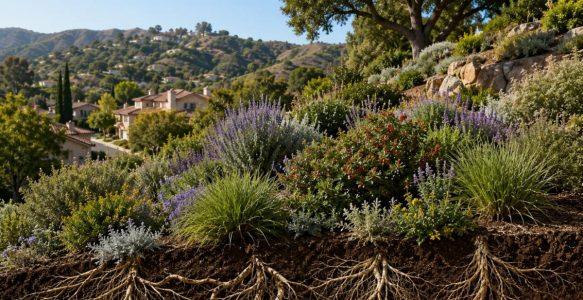
What happens below ground can be just as important as what we see above it. Strong, healthy root systems can help:
- Anchor loose soil
- Reduce erosion and stormwater runoff
- Improve water absorption
- Provide greater stability on slopes
- Help protect vulnerable landscapes following wildfire or heavy rain
For hillside properties, choosing plants for their root structure as well as their appearance can make an important difference.
Deep-Rooted and Firewise When Properly Maintained
✔ Toyon (Heteromeles arbutifolia)
Substantial roots that help stabilize slopes
Provides valuable habitat for birds and pollinators
✔ Deer Grass (Muhlenbergia rigens)
Dense, fibrous root system that helps bind soil
Particularly well suited to hillside planting
✔ Yarrow (Achillea millefolium)
Low-growing native with spreading fibrous roots
Useful for filling spaces between larger shrubs
✔ Coffeeberry (Frangula californica)
Evergreen native with a well-developed root system
Adaptable to many Southern California landscapes
Good Choices With Some Considerations
Ceanothus (California Lilac)
- Well suited to slopes
- Some species become woody as they mature, so regular pruning and removal of dead growth are important
California Sage (Salvia species)
- Provides excellent habitat for pollinators
- Its aromatic foliage contains natural oils, making upkeep especially important as plants mature
Other Natives to Consider
Depending on the conditions on your property, homeowners might also consider Sugar Bush, Lemonade Berry, California Buckwheat, Purple Needlegrass, Bush Sunflower, Hollyleaf Cherry, and Mountain Mahogany.
Three additional choices worth considering are:
Coast Live Oak
One of the best native trees for stabilizing hillsides.
California Fescue
A native bunchgrass with deep roots.
Coyote Brush (prostrate varieties especially)
Frequently recommended by restoration ecologists for erosion control.
Because California natives are adapted to our climate, many require little or no supplemental irrigation once established under normal conditions. Establishment generally takes the first couple of years.
Plants Are Only Part of the Equation
No plant is fireproof. How a landscape is designed and cared for can be just as important as the species you choose. Give plants adequate space, keep them healthy, prune when necessary, and regularly remove dead leaves, branches, and other dry vegetation.
Even a plant considered Firewise can become a concern when it is overcrowded, drought-stressed, overgrown, or surrounded by accumulated dead material.
Diversity Is Better Than One Plant
On a hillside, different plants can perform different jobs. Trees and larger shrubs can provide deeper anchoring roots, while grasses and groundcovers help secure soil closer to the surface. Combining several types of vegetation creates layers of root systems at different depths rather than relying on a single species to stabilize the entire slope.
Soil type, drainage, slope and wildfire exposure also vary from property to property. For steep slopes or areas with significant erosion concerns, consider consulting a landscape professional familiar with Southern California native plants and hillside stabilization.
For homeowners looking for additional information and resources, contact the Los Angeles County Fire Department Malibu Forestry Unit:
942 N. Las Virgenes Road
Calabasas, CA 91302
(818) 222-1108


